Tuesday, November 19, 2013

Divide and Conquer: Cutting up the Canvas

Sometimes, despite my best efforts, I can't make a composition work. Usually it will hang around for a long time, nagging at me to do something, until, to rid myself of the frustration, I'll gesso over the canvas and re-use it. Occasionally though, I like parts of the work enough to want to keep them, and I have had some success with cutting up the canvas and making several smaller paintings out of it. I've yet to try this with a representational painting--now that would be a challenge!--but I've done it several times with abstract work. 

The first time I tried it was with a painting in which I tried to incorporate "windows" into an abstract composition. I never took a photo of it, so I can't show it here. I still like the idea of creating the illusion of looking through the painting at images underneath, and will return to it sometime; but in the case I'm describing the "windows" were the only parts that worked, so I cut all seven of them out, matted and framed them, and called them "Little Paint Poems." I still have three of them, having sold two and given two away as gifts. They are about 3" x 4" in size.

In this case the parent painting never got finished. I tinkered away at it but gave up. The next time I took scissors to canvas was rather different: I felt the painting was finished, and I put a frame on it and hung it on my wall. But somehow I wasn't satisfied with it.


From the Floor
I called it "From the Floor" because it was a more or less accurate rendering of paint spatters on the studio floor. This was the assignment set on the first evening of a course on abstract painting at Langara College. It wasn't until later that I noticed that the shapes suggested sea creatures, an idea that influenced my selection of bits to cut out and keep, and the titles I gave them.

Marine Abstraction 2 - 14" x 10" - 2010
Marine Abstraction 1 - 14" x 10" - 2010


I found a pair of rich-looking gold-painted frames that set off my marine fantasies very nicely, and I sold them soon afterwards.

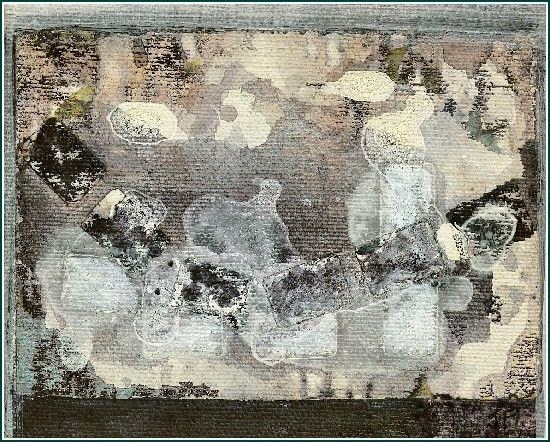
And so to this year, when I participated in a two-day workshop on intuitive painting with artist Eri Ishii. We were asked to use various non-traditional tools (not brushes) and just two or three colours to make marks on unstretched canvas. This is my rather messy effort:

 
Perhaps because of the sombre colours I chose, or else because of the dreary weather that day, I felt almost immediately that my painting represented a battlefield. These were melancholy images of war. They didn't form a composition, but they were powerful. So again I selected bits, and produced four small paintings. I wanted rough edges, so instead of using scissors I tore the canvas, and glued the pieces on to 8" square white panels.


The course of editing, however, did not run smooth. I bought two of the panels from a craft shop, to see if my idea would work. Pleased with the first two paintings, I went back to buy more panels--but of course, I'd had the last two, and they were now discontinued. I tried all the Lower Mainland branches of the store, but with no success. I did track down two more at an art supplies store, but they weren't an exact match, and were quite different on the back, which made framing tricky. Ah, framing . . . I had one suitable black frame, but needed three more. I was delighted to find them all on the same shelf--no chasing around the region this time--but when I'd solved the problem of how to get the frames on to the two different kinds of panel, and hung the four paintings on the wall to admire them, they didn't seem quite right together.  I stared at them in bewilderment, and then measured the frames. One of the new purchases was an exact match for the one I had, but the other two were slightly larger and deeper. I haven't yet had the heart to go shopping again.
Four Images of War - 2013

Friday, October 18, 2013

Call of the Abstract: Truth or Lies?

Galaxy - acrylic - 17'x17" -1999
Knowing that my painting activity this year was likely to be interrupted by trips to England to deal with family matters, I set myself a modest assignment: a series of small non-representational paintings on canvas boards. It had been a long time since I did any abstract painting--here's one example that I still like--and it felt like the right time to try it again. I had learned a lot from painting from photographs, but my last year's work--a series of artists painting or drawing ( Please see Meet the Artists, this blog, November 13, 2012) had taken me as far as I wanted to go in that direction. Apart from a pair of landscapes for a group show, all my painting time this year has been spent creating images that have no basis in reality and not even a mental picture as a starting point. Copying, whether from the real world or from photos, plays no part in this process. My initial intention with each new piece is simply to create . . . something. When it seems to be completed and I can sign and frame it, it is . . . what it is.


This all sounds nebulous and hard to defend. Yet I am certainly not breaking any new ground. Abstract painting is a hundred years old, and Jackson Pollock, perhaps the most famous--or notorious--of the American Abstract Expressionists, died in 1956! My modest little efforts are in the tradition of artists who sought to escape the limitations of realistic representation by creating something from scratch, with as little conscious forethought as possible. It sounds as if it ought to be easy, and occasionally it is; but my experience has been that, while nothing could be simpler than to produce a bad abstract work, creating a good one (and who's to say what that is, anyway?) is almost unbearably difficult. The problem is that there are no external reference points as there are with representational images. A building that won't stand up, water that flows uphill, clouds pasted on a sky . . . all look "wrong" in a landscape. And everyone has a mental picture of how people's faces and limbs should "go" --which is probably why Picasso's distortions continue to cause such bewilderment and derision. But in an abstract work there are no guidelines apart from one's intuitive sense of colour, composition, line, balance--the elements of painting.

Having decided that I needed to do the opposite of painting realistically, or even interpretively, from photos, I was looking for a way to get started when, as often happens, one fell into my lap. An artist called Anita Nairne came to a meeting of the Vancouver Sketch club to give a presentation on her approach to "Intuitive Painting." Anita had her audience members cover a surface with splotches and streaks of paint, working without thought or planning. Next we propped up each piece and studied it from a few feet away, turning the rectangle in all four directions and discussing what images we "saw" in the chaotic mess. The next step, after choosing the preferred orientation, is to pick out the images or shapes one wants to keep and develop, and outline them in chalk. These form the basis of the composition, which can then be completed however the artist wishes.

Anita is not an abstract artist, as you can see from the work on her website,  www.anitanairne.com . However, I saw right away that her method could be applied to abstract shapes, and I began to try it. I used the leftover paint on my palette to daub on my first canvas board, with the results shown.

View 1
View 2
 I settled on View 2 and began a back-and-forth process of over-painting and redrawing as I tried to wrestle the raw beginnings into a finished product. I constantly heard in my head the voice of Lucy Hogg, one of my first painting instructors, as she exhorted her students to "listen to the painting," but to be very careful, because, she would add with a wicked little smile, "It will tell you lies!"

Any artist will tell you that one of the most difficult decisions is when to stop working on a painting, and I've found that even more of a challenge with this way of working. There's the constant danger of pushing the composition too far and losing what one liked about it before. Nevertheless, I do reach a point where I feel comfortable about quitting. My first "Intuition" ended up like this:
Intuition 1 - acrylic - 11"x14" - 2013

 I decided not to give the paintings individual titles, even though I like naming things and some of the images are suggestive of living forms or of quasi-narratives. Just giving them numbers seems to liberate them from specific meaning and to give free rein to the imagination. Here are the next two, the same size as the first:
Intuition 2
Intuition 3 
Intuition 5
At this point I made a mistake and bought a packet of boards that I thought were the same size but were in fact ten inches high instead of eleven. I am at present working on Intuition 9. The process continues to be exasperating, time-consuming, and fascinating to the point of obsession. Each time I have absolutely no idea what the finished product will look like. Now I have them grouped together on the studio wall I am pleased with the effect. But I don't really know what to make of them. What do you think: are they telling me the truth, or lies?
                                                                                 
Intuition 4

Intuition 8
Intuition 6


Intuition 7 - acrylic - 10"x14" - 2013


Monday, February 11, 2013

Apologies to Munch: "The Groan"

Munch's Scream is one of our most familiar images, endlessly reproduced, parodied, reworked and commercialized, as well known as the Mona Lisa. For a few dozen examples, serious, humorous, witty, and vulgar, please go to https://www.google.ca/search?q=munch+scream&hl=en&tbo=u&tbm=isch&source=univ&sa=X&ei=gZkZUe_YK-iAiwKQuIDIAw&sqi=2&ved=0CDYQsAQ&biw=1920&bih=890  . Munch himself revisited the theme several times, expressing the emotional pain that he experienced in his personal life, and by extension, the angst of his times. Obviously I need to apologize to Munch for yet another reworking of his famous image; now I will explain, and try to justify, my doing so.


In the early part of 2012  I made a series of paintings on the theme "Quotes from the Masters."  The idea was to refer to famous works of art without copying them exactly, a requirement I fulfilled by reworking images first by Van Gogh and then by Tom Thomson but changing all the colours to their complementaries. I wrote about my "mutants" in this blog--please see my entries for March and November 2012. For me this was a new and challenging way to work, and to feel closer to the creators of the paintings on which I was focusing my attention.

Around this time, Ruth Payne, who runs the Ferry Building Gallery in West Vancouver, announced a themed exhibition to be mounted in 2013. The theme was "Hungry Ghosts: Living in the Age of Consumerism." The phrase "Hungry Ghosts" was evocative, but didn't mean much to me, and I dismissed the project from  my mind. A bit later, however, I heard Ruth explain that the hungry ghosts, deriving from Zen Buddhism, are mythical beings that are perpetually hungry but can never be satisfied. [Much later I was to learn that the ghosts are unable to swallow because their necks are too thin; if I'd had that information sooner my painting would have turned out rather differently . . . ] The germ of an idea lodged in my imagination, and became gradually more compelling. Could I perhaps "quote" from Munch and turn his screaming figure into a hungry ghost? I bought a book with a good reproduction of one version of The Scream  and decided to keep Munch's composition and colours much the same, while making my figure hugely obese and substantial instead of the original wispy waif. The painting evolved as I worked on it and reflected on the theme. My interpretation is a representation of an eating disorder, and by implication of addictions in general. Like the Zen ghosts, my overindulger is always hungry and never satisfied, regardless of how much she eats. The title that popped into my head one day as I was working refers to the bellyache that the person suffers from eating too much unsuitable food, and the psychic pain of addiction. Of course, it's also a play on Munch's title.

The Groan - acrylic - 24" x 20" - 2012
At first I kept the strong diagonal line of the fence rails or bridge parapet of Munch's painting, but as my figure increased in bulk she squeezed out the background. I had also wanted all along to include a reference to junk food. Timidly I introduced a cupcake or two . . . then more and more . . . until I had a whole incoming tide of cakes that threatened to surround the figure and overwhelm her. So the cakes come to represent the flood of unnecessary consumer stuff, edible and otherwise, that arouses our desires but fails to satisfy for long.

It will have become apparent that for me this had turned into a serious painting on a serious theme; but I have to acknowledge that it also belongs to the long line of jokes at the expense of The Scream. Some of the people who have looked at my painting have laughed--and then felt they had to apologize! A few said they found it disturbing. And a number responded by salivating over the cupcakes!

The Groan was accepted by the jury who adjudicated the submissions, and duly appeared in the "Hungry Ghosts" exhibition in January, along with an interesting and varied collection of two- and three-dimensional work. There is  a satisfaction in responding to a challenge like this one: as with the best art school assignments, they nudge me in directions that would never otherwise have occurred to me.


Tuesday, November 13, 2012

Meet the Artists--in person and on canvas!

In a few days' time, on the weekend of November 16 - 18, along with most of my studio mates, I will be taking part in this year's Eastside Culture Crawl. For me it will be the eighth time I have played hostess in my studio space, first at 901 Main St. and then, since 2010, at Portside Studios, 150 McLean Drive. For detailed information about the Crawl, and to download a map showing all the participating artists and studios, please see www.eastsideculturecrawl.com
If you have never "crawled" before, be warned: this is a very big event with an awful lot to see!The list of artists in the printed brochure takes up four double-columned pages. We are spread over an area extending from Main St. to Victoria Drive and from East 1st Ave. to the Burrard Inlet waterfront. So although there are dedicated Crawlers who make a full time job of it from 5 pm on the Friday through to 6:00 on the Sunday (maybe they are the same people who see ten movies a day during the Film Festival) most people select a few studios, giving preference to artists they know personally or whose work they admire. Another warning--mid-November is not the best time of year for leisurely strolls through Vancouver's streets! Although we have occasionally had beautiful autumn days, my memory tells me it's more  often been pouring, and once we had a blizzard. So a policy adopted by the initiated is to favour buildings like Portside Studios, where there are a number of artists to visit and where once you are inside you are good for at least half an hour and can dry off and warm up.

In my last blog post (October 9, 2012) I wrote about the opportunities that have presented themselves this year to hang paintings on other people's walls. In the case of the Crawl, of course, I'm using my own walls, the ones I rent at Portside. Most of the work I'll be showing is from this year and includes the paintings I've completed so far on the theme "Artists at Work." I referred to two of them last time, but there are eight more. What attracted me to this subject is the intense absorption and concentration of all the artists, amateurs and professionals, who range in age from about twelve months to more than seven decades. As I wrote in "Facing Facts"--please see this blog, September 11, 2011--I like to see children engaged with their whole bodies and all their senses in an activity which, for the time being, is the most important thing in the world. Years ago, as an education student, I read a book by Maria Montessori. I remember almost nothing about it except that Montessori called this concentration "the great work of children," which adults should respect, even revere. I enjoy watching my grandchildren absorbed in their "great work", but I don't believe they have a monopoly on it. Certainly artists at work demonstrate the same attitudes.

The artists I've painted are people of whom I had taken or acquired photographs that I found interesting. They include friends, acquaintances and family members, and one or two whom I met on  painting holidays. I will not give any of them a name, so it's fine if they don't recognize themselves!

Artist in a Field of Gold - acrylic - 2012 - 16" x 20"
First, two people painting outdoors in southwestern France. A group of us were there for a painting holiday arranged by the proprietors of Brambles, an art retreat in Devon, England. (For information about their courses and trips see www.bramblesartretreat.com .) We were in a beautiful rural setting not far from Toulouse and the foothills of the Pyrenees.On a sunny but coolish September morning we strung ourselves out along the side of the road to paint the view across the fields, which included a fine Romanesque church. 
 
Artist in a Bean Field - acrylic - 2012 - 16" x 20"
When artists are busy it is as if they were in their own little world, as if other people didn't exist. The chair backs and the backdrop of trees seem to define these little worlds and separate the artists from the viewer.

 
Bridge on the Lydd


The Red Tractor

The next artist was also a Brambles student, but this time at the retreat in Devon, in June. We had a week of glorious weather and were able to work outside every day. In this picture we were in the yard at Brambles, but we also worked in a farmyard, where I painted "The Red Tractor," and in a partly dried up river bed, which I wrote about in my post of September 13, 2011.
Artist on an Iron Bench - acrylic - 2012 - 16" x 20"


"Artist on an Iron Bench" is perhaps my favourite so far. I like the minimal background and the pinkish colour, which suggests the wall of the old cottage.

Next we go to Vancouver Island and a chilly spring morning. You have to be dedicated to sketch outdoors in anything but perfect weather, but this artist and I dressed warmly and stuck it out for a couple of hours.
Artist in a Forest - acrylic - 2012 - 16" x 20"

The next three artists are members of Vancouver Sketch Club, and as I mentioned last time, were my contribution to the Sketch Club's 60th anniversary exhibition. We were drawing from the model in the Coach House at Hycroft, the headquarters of the University Women's Club of Vancouver. In the case of "Artist in a Black and White Outfit", it was the coordinated outfit itself which appealed to me, whereas in "Artist in a Red Scarf" I particularly liked the network of easels in the background. "Artist in Shirt Sleeves" was a challenge since I changed the background several times, moving the open door, eliminating it completely, and finally reinstating it, since the composition seemed to need something there.
Artist in Shirt Sleeves - acrylic - 2012 - 16" x 20" 
Artist in a Black & White Outfit - acrylic - 2012 - 20" x 16"
Artist in a Red Scarf - acrylic - 2012 - 16" x 20"
                                                     
Shore Line
Artist beside a Pond - acrylic - 2012 - 16" x 20"
I wrote about summer sketching in"The Great Outdoors", August 7, 2012. One of our regular venues is Jericho Beach Park, where there is a variety of subject matter to choose from. Several years ago I spotted the row of elderly ladies that became the painting "Shore Line." This year I photographed the woman who features in "Artist beside a Pond." I particularly liked the way the trees and plants framed her, enhancing the "own little world" effect.

Artist in a Red Chair - acrylic - 2012 - 20" x 16"

Artist with a Green Crayon - acrylic - 2012 - 16" x 20"


Finally, the two youngest of my artists. On one of our summer sketching days a member brought along her grandchildren, whom she was baby-sitting for the day. I loved the way the little girl in "Artist in a Red Chair" had curled herself up as she drew the trees edging the park. Maria Montessori would have been happy to see her, as she would with the baby boy in "Artist with a Green Crayon." Scarcely big enough to see over the table, and with his left thumb an essential part of the creative process, this tiny artist is just as absorbed in his Great Work as any of the other people in my series.

Do come and see the paintings if you are in the Vancouver area, and contact me if you have a photo of your own Artist at Work that you might like to see as a 16" x 20" painting. One condition--no mugging for the camera--your artist must be oblivious to everything except the task in hand! you can send me a message via this sight, or through my website, www.myartclub.com/judith.fairwood


Next blog post? Probably not before January.


Thursday, September 20, 2012

Let it Show! --My Work on Other People's Walls

There are artists who are content to paint in private year after year, squirrelling the fruits of their labours away in their attics and basements. I'm not one of those. For one thing I don't have a basement, or any other place big enough to accommodate what is by now a considerable inventory. And I am fairly prolific: I am now working on my 17th painting of 2012, to give you an idea. So for that reason alone it's a relief to be able to get some of it out of my house and on to other people's walls, even if it all comes back again days, weeks or months later.

There's another purely practical reason. Since 2005, when I obtained my BFA degree and rented a studio space for the first time, I have been conducting my art practice as a "small business." This means that I can deduct my art-related expenses, the greatest of which is my studio rent. The big advantage is that, since at the moment my art business runs at a loss, it reduces my overall income, and therefore my income tax bill. Before I set this up I attended a lecture on the topic, at which an accountant explained the rules, since of course the Canadian government is not enthusiastic about receiving less tax. In general a "small business" must demonstrate that it has "reasonable expectation of profit." However, even the government realizes that for artists "REOP" is a long shot, so it has a second criterion: "active pursuit of profit."  So for me, making an effort to get my work out into places where it will be seen by a wider audience than my family and my studio mates, and where it may possibly attract buyers, is an outward and visible sign of pursuing profit.

Even without these practical considerations it would be important to me to display my paintings. I have a real feeling of achievement in seeing my work displayed in public, especially if I can hang a whole series of related paintings in the same space. Viewers' reactions and comments are fascinating and instructive too. I know that enough people respond positively to my work to make it worth putting it out there for their enjoyment. Canvases stacked in closets or against the wall are not doing anyone much good.

So . . . for all these reasons I submit my work to juries and take part in events and group activities. And this year a whole host of opportunities have presented themselves more or less together, between now and the end of the year. So if you live in the Vancouver area and would like to see examples of my actual work, as opposed to virtual thumbnails, please come to some of the following venues or events. I have already written in this blog about some of the work, and don't want to repeat myself unduly, so I'll just give the reference to the relevant blog instalment. If you want to take a(nother) look at it, just click on the relevant date on the list to the upper right of your screen, where it says "Blog Archive."

First up is a group show with Vancouver Sketch Club, www.myartclub.com/the.vancouver.sketch.club , which is due to open Saturday September 29 in the upstairs lounge of the Metro Theatre, along with the Theatre's next production, I'll be Back Before Midnight, described as "a chilling evening down on the farm"! You can only get in to see the art show if you attend the play, but do come for an inexpensive evening out,Thurs. through Sat. evenings and Sunday matinees until October 27. See www.metrotheatre.com for more information. The theme for our art show is "Quotes from the Masters." I wrote about this project, and the three paintings I planned to submit to the show, in "Getting Going Again: Vincent's Mutants" -- please see this blog, March 2012. However, I sold the paintings shortly afterwards, and painted two different ones for the show. I followed the same procedure--changing the colours of the original to their complementaries--but the "master" I quoted from was Tom Thomson, and the paintings two of his best known, "The West Wind " and "The Jack Pine." You can see the original versions at
en.wikipedia.org/wiki/The_West_Wind_(painting) and
 www.gallery.ca/en/see/collections/artwork.php?mkey=11056 and compare them with my much smaller mutants, each 16" x 18".


Oddly, I found these much harder to paint than the Van Gogh mutants! Less surprisingly, I learned that changing the colours greatly alters the mood of a landscape.


The weekend of Sept. 28 - 30 I will be taking part in an art event called the Main Drift, open to artists who live or work on or near Main Street. I am planning to be in a display space at 350 East 2nd Ave. (the same venue as I was in for the last Drift, in 2010)  from 11:00 am to 5:00 pm on the Saturday and Sunday, with fellow painters Vanessa Lam and Melanie Ellery. For much more information and a map, please see www.thedrift.ca . I will be showing some of my "Watery World" series, which I wrote about in "Reflecting on Reflections," April 2012. Here's "Watery World 4" as an example.

The following week the Vancouver Sketch Club will be hanging another show, this time to celebrate its 60th anniversary. The Club has gone through some drastic changes over the years. It started as an all-male preserve for downtown businessmen who wanted to sketch or paint in the Vancouver Art Gallery. For many years women--the wives of the members--were relegated to the role of refreshment providers and cleaner-uppers at meetings. Eventually some of the wives--supported by a few husbands--rebelled, and were grudgingly admitted to the Club, which now has a predominantly female membership! Our celebratory show will be installed at the West End Community Centre on Denman St. and will run from October1 to 20. There is no specific theme for this show. I am planning to include two or three of the series that has been my main focus this year, paintings of artists at work. What I like about the subject is the artists' complete absorption in their activity; they seem to be each in their own separate world. I have so far completed eight paintings, and want to do five or six more--by which time I'll be ready for a complete change of direction! Here's "Artist in a Black and White Outfit" as an example.

Artist in a Black and White Outfit - 2012 - 20" x 16"


In the same week I'll be hauling off a carload of paintings to a Massage Clinic, www.cambievillagemassagetherapy.ca , where, as a member of the Drift Society, I have been invited to display work for three months--my longest stay to date on Other People's Walls! As with the Metro Theatre, you can only see the work if you patronize the establishment, so if you have sore muscles, here's your chance to combine a massage with art appreciation. I will be sharing the wall space with Melanie Ellery, and am planning to show work which features people. This is work from longer ago, and I have written about most of it before--please see 2011 instalments, especially Feb. 20, March 6, May, June, September and December. For example, I'll be including "Country Church".
Country Church - 2009 - each panel 14" x 11"
November brings our big annual event, the Eastside Culture Crawl, www.eastsideculturecrawl.com ,
when our studio, Portside Studios at 150 McLean Drive, will open our doors for three days. I can't claim that the Crawl will get my work on to Other People's Walls, but I will at least have the opportunity to show it to Other People, and talk to them about it. Maybe even sell some of it . . . or, since I'll be showing my "Artists at Work" series, maybe I'll even secure commissions for further studies of artists! Well, I can fantasize! Here's another Artist at Work:

Artist on an Iron Bench - 2012 - 16" x 20"

And that brings us to December, when I'll be showing a selection of paintings from my series "In Praise of November" at the Hycroft Gallery in the home of the University Women's Club of Vancouver,  www.uwcvancouver.ca  . I wrote about this series in my posts of March 13 and November 2011, and in March 2012. I don't yet know the exact dates of this show, and I'm still deciding which paintings to include, but they will be mostly landscapes and trees. Here's one:


November Snow - 2009 - 20" x 20"


There! A major move in the direction of Mother Hubbard walls, and ample proof for the tax man, if he happens to be paying attention, of my "active pursuit of profit." My showing streak even extends into January--but that's another story!


Next blog post in a month or so. Thanks for reading!


Tuesday, August 7, 2012

The Great Outdoors: A Sketch is Just a Sketch


This post is decorated with pages from my sketch books. As I explain below, I make no claims for these simple efforts: they are just  . . . sketches.

Hostas
Most of my paintings, even my landscapes, are produced in the studio and based on photographs that I have taken earlier and edited on the computer. Some artists, of course, paint outdoors, making a virtue of the constantly changing effects of light and weather. The Impressionists are famous for this approach, with Monet's multiple paintings of the same cathedral or group of haystacks being prime examples. (Please see www.learn.columbia.edu/monet/swf  and www.artsology.com/monetlight.php .)

Hydrangea
Other artists make quick, small paintings on site with a view to elaborating them later into more ambitious compositions. These fresh air enthusiasts may disapprove of painting from photos, and can produce some persuasive arguments to support their opinion. They may say that the struggle to express the reality that confronts their eyes, the challenge of limiting, framing, and editing all that messy detail out there and reducing three dimensions to two, not to mention dealing with changing light and atmospheric effects, makes for an enriched and more lively painting. The freshness and spontaneity of a modest work produced on site can be very appealing, sometimes more so than the large, studio-painted canvas based upon it. See, for example,  www.wikipedia.org/wiki/The_Jack_Pine , where different versions of Tom Thomson's iconic painting are compared. 
Tugs on the Fraser

For myself, however, working only on location would produce very few paintings. For one thing, there's the weather, especially here in the rain forest. You have to be very dedicated to shiver in the drizzle while your paper blows away or your painting goes blotchy. But also there's the lack of privacy. If you work outdoors, unless you take yourself off to the seclusion of the mountains, where you'll  be bothered only by bears, you're subjected to a constant stream of passers-by who are desperate to breathe down your neck and ask what you're doing. Many artists don't mind this at all, and regard the interruptions as opportunities for educating the public and even drumming up sales; but for me the intrusions are annoying, and being "on stage" can revive the panic I felt as a teenager when I had to play the piano for school assembly. I would never have made a performance artist!
Moored in West Van


Despite all this, I can thoroughly enjoy drawing and painting outdoors if I'm part of a class or informal group. There are few more pleasant ways to spend a warm summer day. Safety in numbers means that if I turn my back pointedly enough on the curious strollers they can fasten on a more promising victim. Now that summer has finally come to Vancouver (well, sort of . . .  with all this climate change we can't any longer count on the four to six weeks of solid warm sunny weather that used to define our July and August) I'm once again sketching each Wednesday with members and friends of the Vancouver Sketch Club.

Willow

Our arrangements couldn't be simpler: two of us arrange to meet at a chosen spot, usually a park with a variety of subject material, shade, easy parking and public toilets. We send an email to our list of contacts announcing the place and time, and people either show up or don't. We've had as few as two and as many as thirteen. Some draw, some use watercolours. Some have had lots of experience, some are beginners. We work for a few hours, chat a bit, eat a picnic lunch, and settle on the venue for the following week. If you would like to give it a try, please contact us at www.myartclub.com/the.vancouver.sketch.club.
Trees in Trout Lake - 2012


As well as a pleasure, sketching is always a challenge and a learning experience, a return to the most basic form of art activity and the eye-brain-hand coordination that it requires. At the same time it isn't--or shouldn't be--a stressful activity, because there is no requirement or expectation that it should produce a masterpiece. A sketch is just a sketch, no more and no less, and it makes no more sense to say a sketch is "good" or "bad" than to apply those adjectives to an entry in a personal journal. A sketch is a visual note or record, a quick experiment, and sometimes the first step in a project. For me, if a sketch catches some of the essence of what I'm looking at, it's successful.


Garden Steps


Unless I'm enrolled in a class, I prefer to be unambitious when sketching outdoors. I work small, often using a 6" x 6" sketch book and either pencil or black pen. I'm fascinated by the expressive possibilities of this simple equipment, but still have a lot to learn when it comes to conveying light and dark contrast by shading. The biggest challenge, and one I've been struggling with for years now, is how to capture the variety of leaf and branch shapes that my eyes distinguish. Often there is very little tonal difference between clumps of trees or shrubs, so the contrast has to come from the juxtaposition of patterns. I don't want to get too fussy and outline every leaf, though, so the question is how to create an impression with a minimum of pen strokes. In Trees in Trout Lake (above) I felt that I had come closer than usual to achieving this goal. Maybe this week I'll get there . . . but maybe not. After all, sketching is just sketching.


www.myartclub.com/judith.fairwood 

Next blog post? Well, theoretically in about a month, but my track record this year is not very good.